
Comment: Following, please find fragments of my 2007 article, “New World Order and Education”, that was originally published by a British website Online Journal and then re-published by many indpendent social media outlets worldwide. Here are some key ideas contained in this article as they relate to the role of law and the role of the state in our times. This topic was widely debated in Poland in 1980s, during the “Solidarity” uprising against the rule of Soviet commuinism.
I will begin by highlighting the larger picture in which New World Order policies are placed and applied.
Ideological Competition Is Over
Second World War did not end in 1945. It continued until the collapse of the Soviet Union in 1991. The term “Cold War” referred not only to the arms race but also to the ideological competition between communism and capitalism in which political propaganda played a major role. In response to the Warsaw Pact, the West created NATO. In response to the Workers’ Rights, the West promoted Human Rights. In response to communist social programs, the West established its own social support networks.
Those who grew up on this continent may not understand my conclusions. While living in Poland from 1950s till mid 1980s, I regularly listened to Polish language broadcasts of Radio Free Europe and Voice of America. These propaganda tubes, funded under the umbrella of the U.S. Congress, consistently painted a picture of America as a paradise in which freedom, democracy, human rights, job security, high standard of living and excellent social programs allowed people to live with dignity. ‘Happy American Families’ was the most appealing theme.
On the other side of the Iron Curtain, “representatives of working class” ran communism and working families were supposed to have it better there. By investing in people, by creating higher standard of living and decent social conditions in the West, western elites stirred an ideological conflict in the Soviet Block and inspired revolts in Eastern Europe that contributed to the collapse of the Soviet Union and its empire.
In 1991, the Soviet Union collapsed, the West won the war, and the ideological competition was over. “Restructuring” was implemented promptly and the Western magic carpet began to roll back. And so did our job security, high standard of living, decent social programs, full time jobs, paid holidays, benefits, democracy and the focus on human rights and human dignity in general. It seems that all the goodies we enjoyed in the 1970s and 1980s were not given to us out of a genuine support for decent life of working families. It seems that they were not “won” in a struggle between workers and capitalists. Rather, they were temporarily used by the elites as weapons in the ideological war between the West and the East. The war is now over and so is “capitalism with human face.” Here are some of the battlefields of today:
Culture
“Body and soul make up mankind and all that is human and bears any relation to humanity; all this possesses form and content, an internal and an external side. Fullness of life requires both, for the failure of one leads to dislocation of the whole. To the internal, spiritual side of life belong the concepts of Goodness (morality) and Truth; to the bodily, Health and Prosperity; in addition there exists the category of Beauty common to body and soul. There is no manifestation of life which does not bear some relation to one of these categories, often to two or more. Here every fact and every opinion belongs.” — Prof. Feliks Koneczny, Plurality of Civilisations, 1935.
At the beginning of the 20 century, a new science was born in Europe. It was allowed to grow for three decades before being classified and contained in secret institutions. It was called “Historiosophy” or Philosophy of History. One of the leading representatives of Historiosophy was Prof. Feliks Koneczny of the University of Vilnius.
Koneczny believed that civilizations were formed by people sharing common priorities and common cultural values. He argued that historical changes have always been enabled by dynamically changing values and priorities. His work concentrated on these values and on five domains of human activitiy in which all these values have originated and existed. Following is a short summary of his core theory.
All human activities can be contained in five existential domains. Koneczny called them the Domain of Truth, Goodness, Beauty, Health, and Prosperity. In this summary, we will use more modern terms:
- Intellectual Domain – includes purely intellectual activities. In this domain people try to recognize the Truth and distinguish between True and False concepts. Activities that fall into this domain include education, research, sciences, and all other sources of information based on facts, logic, and rational, realistic approach.
- Moral and Legal Domain – includes moral values and legal regulations. In this domain people distinguish between Good and Bad, and also between Right and Wrong. Fields in this category include religion, traditional customs and moral values, ideologies, as well as the whole cluster of legal sciences and activities.
- Emotional and Spiritual Domain – includes emotions and spiritual experiences. In this domain people distinguish between their likes and dislikes based on their feelings, and experience happiness, sadness, anger, fear, love, hate, jealousy, pride, shame, and spiritual fulfilment. Art, Music, supernatural beliefs, good taste, fashion, religion, fanaticism, sad times, happy times, and many other emotionally loaded activities can be found here.
- Biological Domain – includes all activities that promote and protect healthy living. Examples include food production, healthy diet, active life style, hygiene, and clean environment, as well as all medical and pharmaceutical services.
- Economic Domain – represents all activities that provide material security and well-being.
Using concrete examples, taken from historical sources, Koneczny showed that many of the basic cultural values contained in each of these five domains are common between different civilizations. For example, most civilizations recognize killing, stealing, lying, and cheating as Bad and Wrong. However, many other values may be interpreted differently. What is deemed true in one culture, may be deemed false in another. For example, the story of Creation in different religious traditions differ from each other and differ from the theory of evolution. Another example is the old East Indian tradition of (male) public masturbation, as an expression of religious ecstasy, which could hardly be recognized as “Beautiful” by any Western cultural or religious standards.
According to Koneczny, differences within specific domains have a minor impact on the culture as a whole. What is more important is the hierarchy of the domains themselves. To understand it better, write down the five existential domains in order of your priorities, from the most important in your life, to the least important. For example, here are some personal (or cultural) value systems I have observed in different people and different cultures:
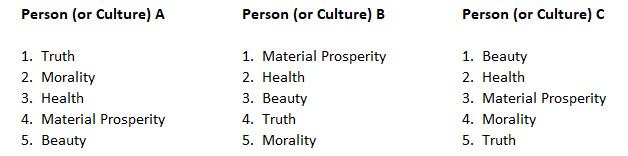
Note that the first, the top domain (or value) is especially important, as it is the one for which you will sacrifice all other values, whenever you make your choices. Even though different people will come up with different priorities, and consequently will make different choices in their lives, culture on a scale of nations can be defined as a prevailing system of existential domains, usually supported by local religions or ideologies, and accompanied by the Triple Law governing the organization of clans: Family Law, Property Law, and Inheritance Law. Using this classification, Koneczny concluded that there were only between 20 and 30 different civilizations in all human history. Seven of them still exist today.
How important is culture? Nations that have been wiped off the map know that preserving cultural values, when all other means of resistance fail, is the only way to stay strong and united. People in Quebec have preserved their national identity for hundreds of years. Poland has regained independence after 10 generations of partition and foreign occupation. Culture is a backbone of a nation. This is why the burning of libraries and destruction of culture always accompany occupation, annexation, and assimilation efforts. Resistance and patriotism are proportional to the degree of national and cultural identity, so they, too, have to be destroyed.
I have a strong feeling that we are experiencing the same social engineering initiatives today. They are better camouflaged but I can see many examples of a deliberate destruction of traditional Western culture that is being sacrificed on the altar of the New World Order. Since the collapse of Soviet Union in 1991, we witness an unprecedented attack on nationalism, family, religion, education, human rights, labour movement, and every institution promoting patriotism, critical thinking and social solidarity. This also explains why “the system” supports “multiculturalism”, and other modern “trends” as opposed to traditional customs and values. Big push to derail the young generation into the virtual reality and artificial world of computer and video games completes the picture. (“Boys don’t play with their sticks anymore” – George Carlin).
The Role of the State
Political systems become “official” and “binding” through an organization called state. States, with their legislative, executive and judiciary branches, provide the elites with means of control that keep in check the rest of the society. Manipulation of public opinion through “embedded” media and powerful lobbies, through which the elite ensures the support of the “representatives of the people”, complete the picture. This role of a state is universal and applies equally to kingdoms, to most of the so called western democracies, to communist or other totalitarian dictatorships and to states run by religious fundamentalists. The name is not important; what counts is the mechanism, the way it works.
In an ideal world, the state would promote and protect the cultural values historically developed and traditionally accepted in a given society. Such a state would act as an “a posteriori” stamp guarding and reflecting the popular values, traditions, and aspirations of its population. In most cases, however, we see the opposite situation. The state becomes an “a priori” tool used to implement policies that serve the best interest of an outside force (a foreign power or an occupant), or the best interest of a domestic minority (the elite). These policies are forced upon the majority without any regard to their historical and cultural background and often, without any regard to the official democratic obligations of the state itself.
New World Order
According to many progressive thinkers, the New World Order is an attempt, by international elites, to monopolize our political and economic reality on a global scale. Meaningful democracy is only possible, when people can make informed choices, when they are educated and have access to true information, when they are able to apply critical thinking skills. Successful implementation of the New World Order would mark the end of democracy, the end of national self-determination, the end of human rights, and the end of many publicly run services (including health care and education.) New World Order also includes demographic modifications, especially depopulation aimed at reducing the world’s population and migrations – (mixing of cultures).
An open announcement of these changes would most certainly cause massive protests worldwide. This is why they are being introduced gradually, secretly, and with a great degree of disinformation. The use of powerful lobbies and financial incentives to corrupt politicians, the use of a network of strategically placed enablers, and the use of corporate media to cover up the truth and indoctrinate the masses show that preparations for this operation took a lot of time and planning. Lack of substantial opposition within the system also proves the presence of an organized web of willing collaborators who have infiltrated the system and are doing the “dirty work” for the unelected and hidden real rulers..
It is often hard to believe that the elites managed to extend their power over so many control posts across the combined economic, political, and social spectrum of our life. Perhaps this is where the scepticism and the term “conspiracy theory” originate from. Unfortunately, the fact that all changes point in one direction, excludes the possibility of a coincidence. Opportunism and conformism are wide spread in a society that continues to liberate itself from any restrictions, moral values included.
As part of the New World Order agenda, all sources of independent cultural values have been placed under attack. This includes the institutions of family and church, the organizations of human rights, labour, and international law, as well as many traditional means of promoting moral values (for example in literature, art, and media.) We see increasing support for multiculturalism and deregulation of most cultural, moral, and national standards. We are witnessing unprecedented attempts to “deregulate” traditional family model, to weaken parental authority, and to reduce the quality time families spend together. We see underfunding, overloading, and confusing of public education and public health care in an attempt to destroy their effectiveness and prepare them for privatization. We see the closing of affordable, out-of-town, recreational opportunities for working families in an attempt to contain lower class masses in city ghettos. We witness efforts to reduce various survival and ‘handy-man’ skills, resulting in increased public dependency on state and corporate services. We see the cost of living growing to unreasonable levels. Consequently, we see decreasing standard of living and increasing poverty, a trend that makes it impossible for most working families to achieve financial independence, a trend that traps people in mortgages and credit loans for a lifetime, a trend that enslaves people. When you create conditions in which people are struggling to keep their jobs and buy food for their children, people stop cooperating and start competing. This is the end of solidarity and ability to resist the changes. Considering that all these “restructuring” reforms started to take effect immediately after the collapse of the Soviet Union, this, too, can hardly be seen as a coincidence.
In a rich country people should be rich. System that increases the wealth of the elites at the expense of the masses is a colonial system focused on exploitation. Since the end of the Cold War, people became another commodity.
Family
Family has always been the basic unit of society, one in which values and culture were created and preserved independently of political and economic influences. If you destroy traditional model of family and dissolve culture in communities, creative cultural abilities of the population will collapse and the society will become dependent on political and corporate overseers.
Much has been done in the last 16 years (written in 2007) to achieve this goal, relaxed family laws and “liberating” media campaigns included. Perhaps the most serious damage to the traditional model of family came with the new employment policies. Fewer full time jobs, reduction of benefits and paid holidays, and lower employment security resulted in overloads and stress. Parents work longer and often irregular hours, quality family time is shrinking. Children are brought up by TV cartoons and video games, in a completely unrealistic virtual world controlled by corporations. Schools are taking over the parental role and introducing various virtues / values / character traits programs, which further reduces instructional time needed to teach academic subjects and meet curriculum expectations.
In the atmosphere of constant uncertainty, opportunism and conformism replace integrity and traditional values. Model of family, that used to preserve these values, is quickly disappearing.
























 My Dundas Valley