A 6-Part Master Series by Randy Hillier:
- Chapter 1: The Invisible Silk
- Chapter 2: The Scripted Soul (The Faustian Bargain of Man the Actor)
- Chapter 3: The Collective Addiction (The Rot of the Silk)
- Chapter 4: The Flaw of the Modern Mind: Why Dystopia’s Web Always Feels Normal
- Chapter 5: Asymmetric Resistance: How the Meek Scale Down to Shatter the Web
- Chapter 6: The Opaque Trap of Banker Feudalism

Chapter 6: The Opaque Trap of Banker Feudalism
The modern world operates under a system of Banker Feudalism—an invisible web woven from absolute convenience and easy credit that transforms individuals and politicians into mere actors within a corporate-controlled theater. International banking cartels and government bureaucracies have replaced transparent, localized financial institutions with an opaque web of institutional ownership and double-entry digital ledgers.
Banker Feudalism has quietly replaced the old but well-understood concepts of Capitalism, Communism, Socialism, or Fascism as a nation’s economic operating system. Just as society systematically replaced MS-DOS with Windows, or cursive writing with a digital keyboard, this administrative software update was installed over the global economy without a whimper or a whisper from the population. Most people still argue over the political labels of the 20th century, completely blind to the fact that the underlying code of their society has been entirely rewritten.
Banker Feudalism is socialism in reverse. While classical socialism claims to redistribute wealth downward to the workers, this inverted matrix redistributes wealth from the bottom up—from the laborers to the bankers. The intermediary or lesser lords—governments and corporate Oligarchs—merely manage the fiefdoms, extracting their own lucrative slice of the pie on the upward velocity of the capital.
This total extraction is accomplished through three precise mechanisms:
1. The continuous devaluation of the dollars you earn through expanding the money supply.
2. The deliberate prevention of governments from self-financing, forcing the public treasury into permanent dependency.
3. The total control of the means of production, which is no longer held by private individuals or by the state, but by the banks’ absolute monopoly ownership of credit creation.
This dystopian web of financial extraction is not new. It is a recurring historical meat-grinder that has been undertaken repeatedly throughout history—from the clipping of silver coins in ancient Rome to the hyper-leveraged paper printing of the Weimar Republic, straight through to the engineered 2008 housing bubble and global crash. But the hyper-accelerated, borderless scale of our modern digital web makes all previous historical collapses pale in comparison.
── The Disappearance of Dollar Value
Consider the undeniable, ground-level proof of this first mechanism: the continuous devaluation of the dollars you earn.
In late 1974, when Canada formally signed the Basel framework and pivoted away from its sovereign monetary model, a single paper $10.00 bill held immense physical power. At that exact time, a licensed Ontario electrician earned an average wage of roughly $10.00 per hour. This meant that exactly one single hour of his hard, physical labor was worth a green paper bill.
For that working man, that one hour of labor was his complete weekend ticket. It bought a full “two-four” case of beer from the Brewers Retail (approx. $4.60) and a full carton of 200 cigarettes (approx. $4.80). He walked out of the store with change in his pocket, holding the tangible, complete rewards of just sixty minutes of his physical life.
If that electrician took an identical paper $10.00 bill earned from an hour of work in 1974, resisted the urge to spend it, and tucked it away safely under a workshop floorboard until today, November 2026, the absolute theft of the ledger is laid bare.
Today, if he pulls that paper $10.00 bill out from under the floorboard and walks into a modern store, it cannot buy a single six-pack of beer, let alone a single pack of cigarettes. In modern terms, a standard case of 24 beer costs roughly $60.00, and a carton of cigarettes has skyrocketed to nearly $150.00. To purchase the exact same weekend provisions that cost him a single hour of labor ($10.00) in 1974 now requires an astronomical $195.00 of modern fiat paper currency.
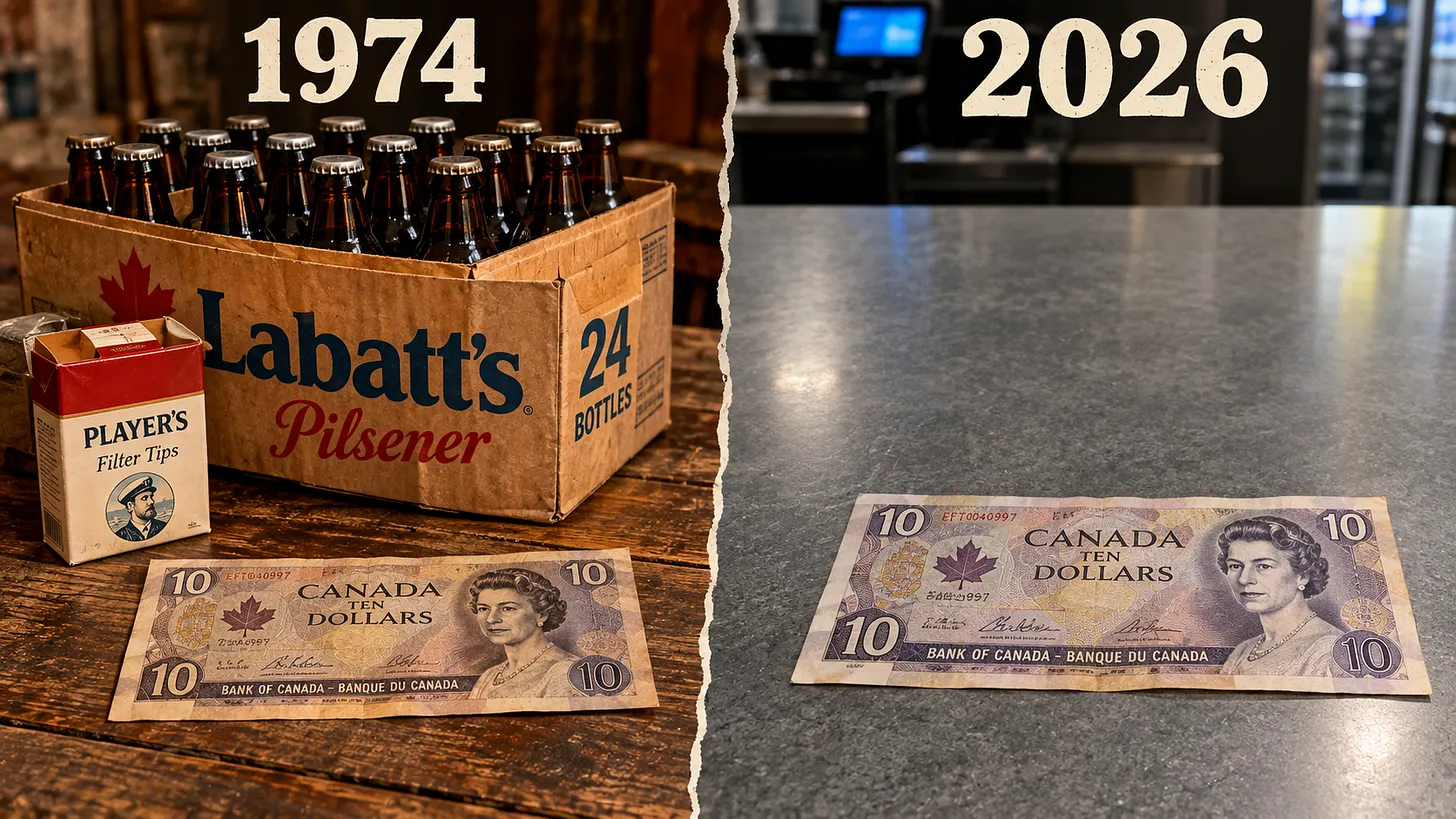
Think about what this means. Even if a modern electrician makes a strong wage, he must work nearly 4 hours today just to buy what his predecessor bought with a single hour of sweat in 1974.
The bank did not break into his workshop. The $10.00 paper bill remains completely un-smudged under the floorboard. Yet, the commercial banking cartel—by typing trillions of dollars of digital credit into their double-entry ledgers out of thin air—quietly vaporized 95% of that electrician’s stored labor.
The financial system successfully executed an asymmetric trade. They allowed the worker to expend the limited hours of his physical life to wire houses and build communities in 1974. Then, they used the software update of Banker Feudalism to systematically skim away the wealth those hours originally commanded, transferring it directly into the hands of the Bankers, the unseen owners of the Dystopian global market place.
The Disappearance of Local Finance
To cement this monopoly, the financial spiders first had to systematically dismantle the human-scaled, independent alternatives that protected the fruits of local labor.
- The “Mr. Potter” Archetype: In the classic film It’s a Wonderful Life, the predatory banker Mr. Potter was the central villain. He was ruthless, but he had a face. You knew exactly who owned the debt of Bedford Falls, and you could look him in the eye in his boardroom. Today, the system has completely eliminated Mr. Potter. Modern financial power is entirely faceless, hidden behind an impenetrable, circular maze of cross-shareholding structures and trillion-dollar asset management conglomerates like BlackRock and Vanguard. The modern bank branch is merely a corporate kiosk connected to an un-auditable, centralized global ledger.
- The Extinction of Alternatives: In my youth, the financial landscape was diverse and anchored in real-world productivity. Communities relied on a robust network of independent Trust companies, Savings and Loans associations, and localized Credit Unions. These institutions knew the character of the local builder or farmer because they lived on the same streets. The banking cartel used escalating, centralized regulatory costs—the early seeds of the international Basel accords—to systematically squeeze smaller competitors out of existence. In Canada, this manifested as a sweeping corporate liquidation: iconic, independent giants firms Canada Trust, Royal Trust, Victoria & Grey, and Permanent Trust were systematically swallowed, absorbed, and digested by the Big Six commercial banking monopoly. The diverse financial ecosystem was flattened into a single, inescapable grid.
The State as Captive Accomplice
Rather than acting as a neutral regulator protecting the citizen, governments entered a dangerous Faustian bargain with the financial sector, trading sovereign currency creation for short-term political funding. A pivotal turning point occurred in December 1974, when Canada formally abdicated its monetary sovereignty, joined the central bankers’ club at the Bank for International Settlements (BIS), and adopted the foundational framework of the Basel Committee.
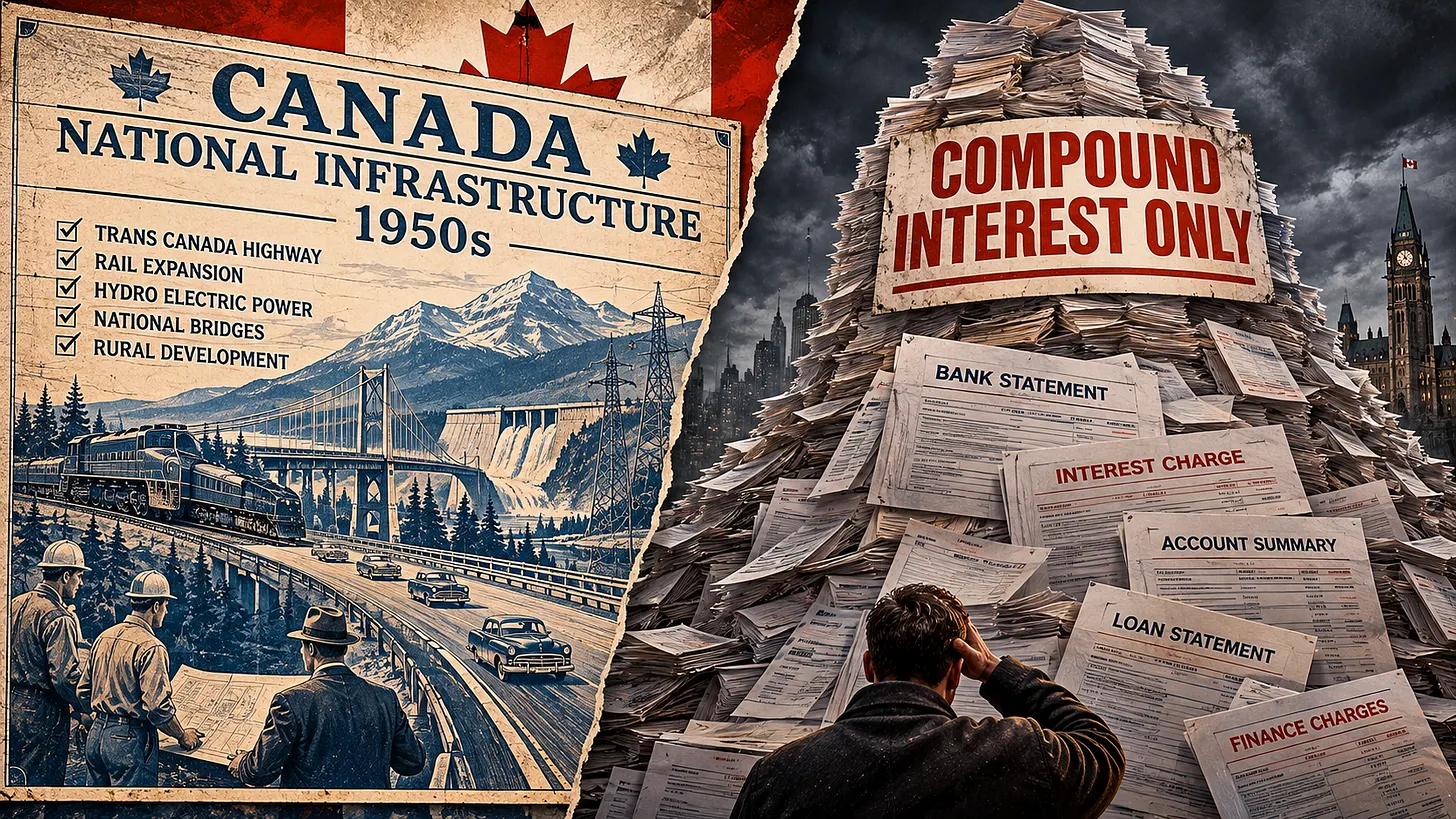
- The Pre-1974 Sovereign Model: From 1935 to 1974, the Bank of Canada functioned as a true public asset. The federal government funded its most historic war and peacetime achievements—the construction of the Trans-Canada Highway, the St. Lawrence Seaway, hospitals, and airports—by borrowing virtually interest-free money from its own publicly owned central bank. Because the Bank of Canada belonged to the people, the interest paid on these infrastructure loans was simply returned straight back to the federal treasury as a year-end dividend. The system was interest-neutral to the Canadian public, allowing the country to build a prosperous industrial infrastructure while keeping national debt remarkably low.
- The Private Market Pivot: In late 1974, under the direction of international central banking Oligarchs, Pierre Elliott Trudeau’s administration executed the great surrender. Under the guise of controlling inflation, the government prohibited direct public borrowing and forced the federal and provincial treasuries to borrow from the private commercial Banks. From that moment on, Ottawa had to issue high-interest bonds to private commercial banks, who then digitally manufactured credit to fund the state. The mathematical devastation of this pivot is undeniable: In 1993, the Auditor General of Canada released a stunning, landmark report confirming that of the $423 billion in net federal debt accumulated since the mid-1970s, a staggering 91% ($385 billion) was not spent on roads, services, or social programs—it was purely the compound “interest-on-interest” paid directly to the private banking cartel.
The Psychological Illusion of Ownership
The true genius of Banker Feudalism lies in its ability to hide the chains that shackle us. The medieval serf or peasant suffered under a brutal system, but they were under no illusion about their reality: they knew they owned nothing, that the Lord owned the land, and that their labor was being extracted for the King’s luxury.
The modern citizen, however, suffers from a deep cultural amnesia akin to Winston Smith in George Orwell’s 1984. Coddled by the narcotics of digital convenience, one-click ordering, and easy plastic credit, the modern consumer goes to work and proudly declares, “I own a home.”
But they do not own it. Under the modern double-entry ledger system, the bank did not move existing wealth to fund the purchase; the bank typed a digital credit entry into existence out of thin air for free, bought the property, and handed the citizen a 30-year leash called a mortgage—a term derived from Old French meaning a “death-pledge.”
The modern serf spends the prime years of their physical life and limited human energy working to service that virtual ledger entry, all while paying compounding property taxes to the State. The moment they stop performing on that digital stage, the illusion instantly evaporates, and the higher lords reclaim the asset. They own nothing, yet they are trained to love their security blanket.
A Path Toward Resistance
Because the state bureaucracy and the commercial banking apparatus are two sides of the exact same trap, systemic reform cannot come from political petitions, legacy courts, or top-down elections. The politicians are merely actors whose campaigns and sovereign debts are entirely captive to the Banks.
True resistance requires a deliberate, asymmetric scaling down. We must stop trying to fight the machine using the machine’s own hyper-scaled tools. Survival requires an intentional step into the margins:
- Starve the Monopoly: Disconnect from the automated digital subscription networks and data grids that track, register, and monetize your habits.
- Reclaim the Tangible: Intentionally utilize physical cash to deny the surveillance state its data stream, and support independent, local merchants who operate outside the corporate oligopoly.
- Build the Micro-Community: Form decentralized, human-scaled groups within your local geography where a man’s reputation is directly and constantly verified by his real-world actions among his neighbors, rather than an algorithmic metric. Combine your stored memories to build alternative educational and physical supply chains.
Winston Smith remained helpless because he tried to navigate the dystopia alone, relying entirely on a broken material world. True freedom begins by recognizing the sticky geometry of the web, turning off the spotlights of the corporate stage, and rebuilding a world of character, trust, and self-reliance within the local margins.
Randy Hillier-No More Lockdowns–
No More Lockdowns Canada | Randy Hillier is a
reader-supported publication. To receive
new posts and support my work, consider becoming
a free or paid subscriber.
—
- Chapter 1: The Invisible Silk
- Chapter 2: The Scripted Soul (The Faustian Bargain of Man the Actor)
- Chapter 3: The Collective Addiction (The Rot of the Silk)
- Chapter 4: The Flaw of the Modern Mind: Why Dystopia’s Web Always Feels Normal
- Chapter 5: Asymmetric Resistance: How the Meek Scale Down to Shatter the Web
- Chapter 6: The Opaque Trap of Banker Feudalism