A 7-Part Master Series by Randy Hillier:
- Chapter 1: The Invisible Silk
- Chapter 2: The Scripted Soul (The Faustian Bargain of Man the Actor)
- Chapter 3: The Collective Addiction (The Rot of the Silk)
- Chapter 4: The Flaw of the Modern Mind: Why Dystopia’s Web Always Feels Normal
- Chapter 5: Asymmetric Resistance: How the Meek Scale Down to Shatter the Web
- Chapter 6: The Opaque Trap of Banker Feudalism
- Chapter 7: Fiscal Stockholm Syndrome — Why a Banker Inherited Canada’s Throne

Chapter 7: Fiscal Stockholm Syndrome — Why a Banker Inherited Canada’s Throne
Dystopian societies seldom, if ever, use iron bars or armed guards to keep its population in line. Like Winston Smith sitting comfortably in front of his telescreen in 1984, modern Canadians wrap the soft blanket of the system tightly around themselves and see their freedom through the lens of captivity.
Nowhere is this psychological paralysis more obvious than in how Canadians view taxes.
Once Parliament surrendered its power to finance itself in December 1974—handing money creation to private commercial banks and committing the public treasury to the never-never plan of perpetual compound interest—the state needed a guaranteed, inescapable way to pay its new masters: the banks. It found that revenue inside the pockets and purses of ordinary working families. To entrench this dystopian feudalism, Mark Carney has been placed on Canada’s Throne to be the final transition away from the pretense of a representative democracy.
Ask an average Canadian about taxes today, and you will witness a textbook case of Fiscal Stockholm Syndrome. Just as a hostage begins to sympathize with, defend, and even praise their captor, the modern Canadian has been conditioned to love the very spider that harvests their life’s energy and labour. Even worse, many feel a surge of gratitude every April when Ottawa hands back a few crumbs of our own stolen wages as a “tax refund.” And we join, donate, volunteer, and applaud the very political parties that aid and abet in draining the nation dry and propping up the Banker’s Feudal State.
── The Two Ledgers: Sweat vs. Surplus
To break the spell of Fiscal Stockholm Syndrome, you only have to set two ledgers side by side: what ordinary Canadians own and pay versus what corporations own and pay.
Across Canada today, 41.8 million people hold roughly $19.1 trillion in total household net worth—most of it locked inside mortgaged homes and retirement savings built over a lifetime of work and labour. Standing across the ledger are 3.3 million registered corporations holding more than $20 trillion in assets.
Both sides of the ledger hold roughly the same mountain of wealth. Yet when the tax bill arrives, the illusion of fairness evaporates:
• Individuals Carry the Load: Personal income taxes and Employment Insurance payroll deductions generate nearly 60% of all federal tax revenue (52.2% from personal income tax alone). When you add sales taxes, payroll deductions, and local property taxes, individuals pay roughly 85% of every tax dollar collected in Canada.
• Corporations Pay Just a Fraction: Corporate income taxes make up just 22% of federal tax revenue—and barely 15% of all taxes collected across federal, provincial, and municipal governments combined.
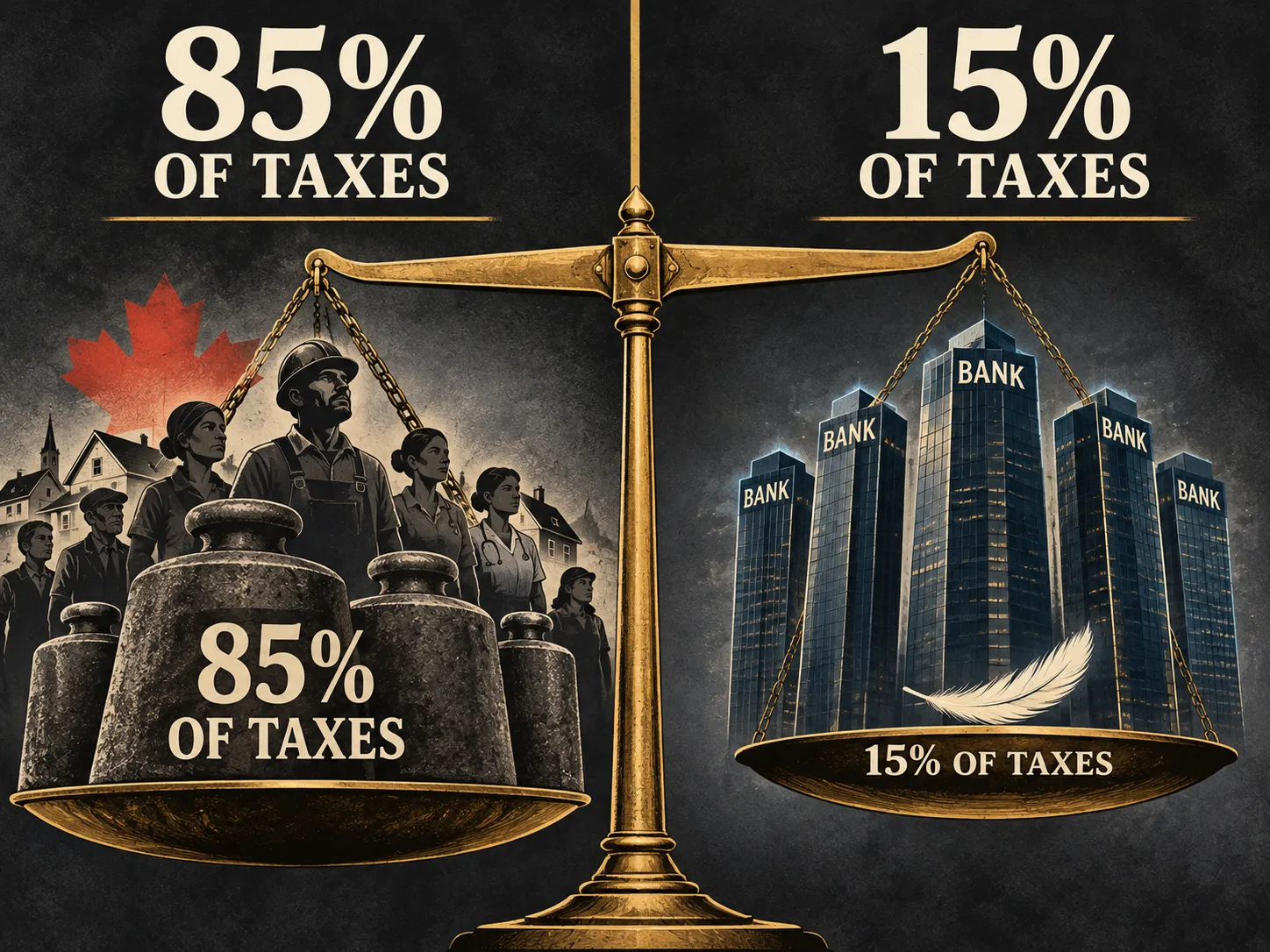
This lopsided harvest rests on a simple accounting sleight-of-hand. An individual worker is taxed on gross income from the very first hour of physical labour. You cannot deduct the groceries that fuel your body, the roof that keeps you warm, or the gas needed to drive to work. Every hour and every dollar of your labour is taxed immediately at 100% inclusion.
A corporation, however, is taxed only on net surplus. It deducts its entire existence—its offices, vehicles, meals, travel, lawyers, loan interest, and equipment wear—before calculating a single penny of tax. What remains is taxed at a fraction of a worker’s rate and locked inside corporate vaults, where it compounds for decades untouched by personal income tax.
── Six Banks, Half the Empire
If the gap between people and corporations is striking, the concentration at the very top of the pyramid is staggering.
Out of 3.3 million corporations holding $20 trillion in corporate wealth, just six of them own nearly half of it all: Canada’s Big Six chartered banks (RBC, TD, Scotiabank, BMO, CIBC, and National Bank).
In their 2025 annual reports, those six banks reported a combined balance sheet of $9.09 trillion in total assets—nearly half of all corporate wealth in the country, and nearly half the combined net worth of all 41.8 million Canadians. On that $9 trillion fortress, the Big Six pulled in $86.15 billion in pre-tax profits, harvested largely from government debt interest payments, mortgages, credit cards, and fees paid out of Canadians’ after-tax paycheques.
While Canadian workers paid $280.2 billion in federal income and payroll taxes, the six banks paid just $16.29 billion in taxes—an effective tax rate of 18.9%, but nearly a third of that was paid to foreign governments rather than to Canada. Measured against their $9.09 trillion empire, the Big Six paid less than two-tenths of one percent (0.18%) in income tax. An entry-level nurse or tradesperson in Ontario pays a higher marginal tax rate on their labour than Canada’s banks pay on tens of billions in profit.

Think about the moral inversion we have been trained to accept as normal: if a desperate individual walks into a branch with a note and robs a bank, the full weight of the state crushes them for a grave criminal offence. Yet when six chartered banks legally siphon tens of billions of dollars out of working families through credit creation and compound interest while paying a fraction of a worker’s tax rate, the headlines applaud their “record quarterly earnings” and celebrate their stability.
── The 1974 Amnesia
Like the boiling frog in Chapter 3, Canadians accept this 85-to-15 tax split because institutional amnesia has erased our memory of what came before.
In 1966, Kenneth Carter’s Royal Commission on Taxation handed Parliament a simple, moral rule: “A buck is a buck.” Carter warned that if tax laws gave corporate profits and investment gains a better deal than wages, wealthy elites and corporations would hoard capital inside tax-sheltered shells while shifting the cost of government onto working families. Parliament praised Carter’s words but then buried his book of reforms—granting capital gains a 50% tax-free discount, abolishing inheritance taxes, and slashing corporate tax rates in half while keeping workers locked at 100% taxation on every paycheque.
Look back to 1974, the very year Canada surrendered its monetary sovereignty:
• Direct Hits on Your Paycheque: Across all levels of government since 1974, politicians steadily shifted the tax burden directly onto workers’ paycheques, pushing personal income and payroll deductions from 40.8% of all government tax revenue in 1974 up to nearly 60% today.
• The Banking Explosion: In 1974, every chartered bank in Canada combined held $97 billion in assets—equal to 61% of Canada’s entire economy (GDP)—and paid corporate tax rates of 48% to 50%, contributing more than 10% of all federal corporate taxes. Fifty years later, after zero reserve rules, trust-company buyups, and offshore tax-haven loopholes, the Big Six banks hold $9.09 trillion—nearly 290% of Canada’s entire economy. Their footprint grew five times faster than the economy, yet their share of Ottawa’s tax revenue actually shrank by a third.
• The Royal Rewards: What is taken with one government hand is returned with the other Royal hand. The 15% corporate share of Canada’s taxes is a duplicitous double-entry ledger when compared to the other side of the ledger of corporate rewards. Canadian corporations receive $87 billion in direct government subsidies and assistance, nearly extinguishing or cancelling their entire tax burden.
── The Great Mobility Reversal
To ensure the captive taxpayer never questions the ledger, the unseen global web executed a quiet reversal of freedom over the past fifty years.
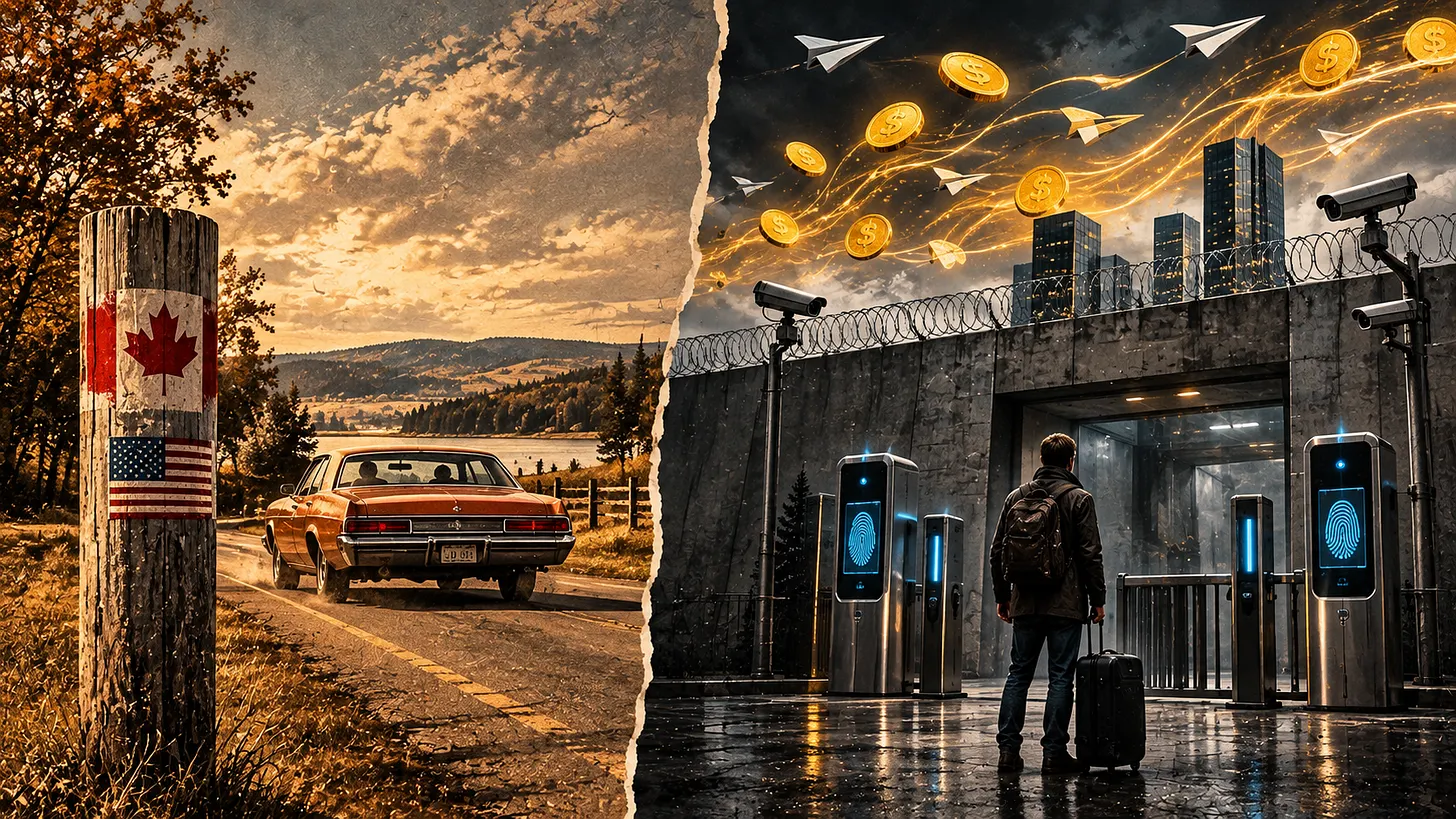
In my youth during the 1970s, a Canadian could drive across the border into the United States with no passport, no fingerprint scan, and no border interrogation—often crossing with a simple wave or a driver’s licence. Money, however, was kept on a tight leash. Strict currency rules and capital controls prevented corporations and wealthy elites from moving fortunes offshore at will, allowing nations to tax capital and labour on far more equal terms.
Today, that world has been turned completely upside down:
• People Are Walled In: Crossing that same border now requires biometric passports, digital tracking, and strict work visas. Professional licensing boards anchor workers to a single province. And if an individual finally packs up their family and leaves Canada, Ottawa hits them with an immediate departure tax—treating every non-registered asset as sold the day they leave and taxing the paper gains on the spot.
• But Capital Is Borderless: Corporate empires and digital money need no passport, no visa, and no licence. Trillions of dollars flash across oceans in milliseconds. When Brookfield Asset Management moved its head office from Toronto to New York to tap into giant American index funds, it kept its Canadian incorporation papers tucked safely in a drawer and paid $0 in exit tax. Multinational corporations routinely leave empty legal shells behind in Canada while shifting factories, patents, and profits into foreign subsidiaries without paying a penny to leave.
Breaking the Spell
Fiscal Stockholm Syndrome survives only so long as the captive mistakes the hostage-takers as a friend. Once you see the two ledgers clearly—once you see six banks holding half of Canada’s corporate empire while 41.8 million citizens carry 85% of the state’s tax load—the moral illusion shatters.

You cannot cure Stockholm Syndrome by begging the captor for better terms, nor by voting for new actors to read the same rigged script. Stepping free begins the moment you stop confusing tax compliance with civic virtue, reject debt-fueled consumption, and shift your productive life into the local margins—trading skill for skill, using tangible cash, and building self-reliant communities of character where your labour belongs to you and your neighbours, not to a global Banker’s ledger.
No More Lockdowns Canada | Randy Hillier is a
reader-supported publication. To receive
new posts and support my work, consider becoming
a free or paid subscriber.
—
- Chapter 1: The Invisible Silk
- Chapter 2: The Scripted Soul (The Faustian Bargain of Man the Actor)
- Chapter 3: The Collective Addiction (The Rot of the Silk)
- Chapter 4: The Flaw of the Modern Mind: Why Dystopia’s Web Always Feels Normal
- Chapter 5: Asymmetric Resistance: How the Meek Scale Down to Shatter the Web
- Chapter 6: The Opaque Trap of Banker Feudalism
- Chapter 7: Fiscal Stockholm Syndrome — Why a Banker Inherited Canada’s Throne